
How to Find Good Domains to Buy on GoDaddy Auctions
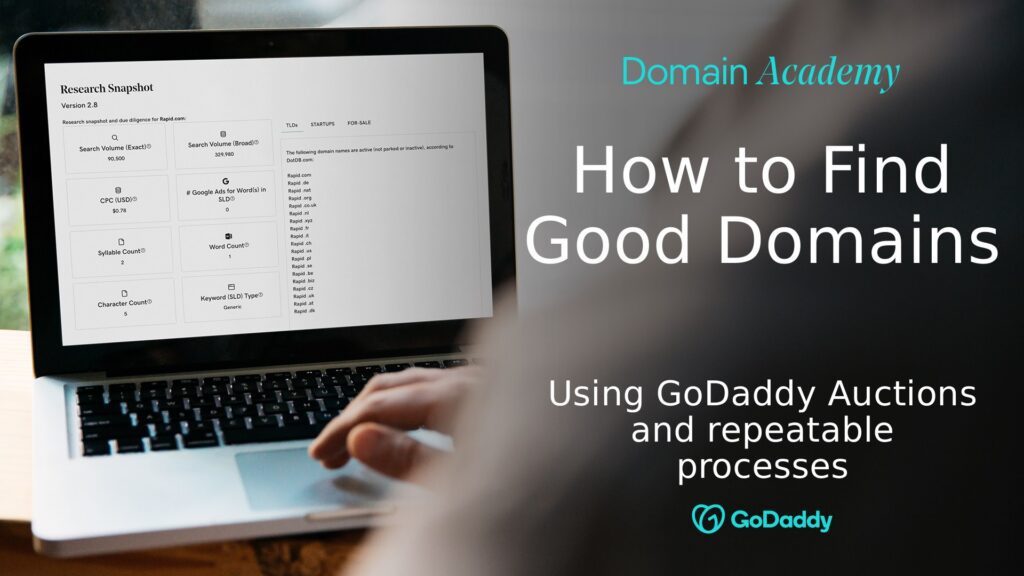
Finding good domains to buy is not a matter of luck. It is a repeatable process built on clear criteria, the right tools, and a disciplined approach to filtering large lists down to a handful of real opportunities. This article walks through that process from start to finish — what makes a domain worth buying, where to find candidates, how to evaluate them, and how to use automation to make the entire workflow more efficient.
Domain investing is also a field that changes. The extensions that sold well three years ago are not always the same ones selling well today. The tools available to investors have shifted significantly in a short period of time. Domain Academy runs live sessions and publishes updated content specifically to keep investors current as the market evolves. What follows reflects the most current thinking from those sessions.
If you prefer a structured, at-a-glance version of this content, see the full session recap for finding good domains on GoDaddy Auctions.
What Makes a Domain Worth Buying
Before you search for anything, you need a working definition of quality. Without it, every name on a list looks like a potential buy.
A strong domain name has several characteristics. It is short. It is easy to spell and pronounce. It contains a keyword or brand element that real businesses search for or identify with. And it sits on an extension — also called a TLD, or top-level domain — that buyers actually trust and pay for.
The second-level domain (SLD) is the word or phrase to the left of the dot. The TLD is everything from the dot onward: .com, .net, .org, .ai, and so on. Both matter to value.
On the TLD side, .com remains dominant by a wide margin. Based on real sales data covering approximately 150,000 transactions over $1,000 in the past two years, .com accounts for roughly 72 to 75 percent of all sales. .org comes in second at around 8 to 10 percent. .ai has been growing quickly and sits at roughly 4 to 6 percent. .net, which many investors once treated as a reliable secondary choice, has declined to around 2 to 3 percent of sales and continues to trend downward. .co has been moving in the opposite direction, with solid recent sales and increasing buyer interest.
The .ai extension deserves a specific note. It is currently active and selling well, driven by the volume of companies launching with AI-related branding. Whether that demand holds long-term is uncertain. What is certain is that it is a real market right now. Ignoring it entirely means missing current opportunities.
On the name side, the things that reduce value are equally straightforward: hyphens, numbers, multiple words strung together, and anything a caller would have to spell out over the phone. These characteristics do not make a domain unsellable, but they make it significantly harder to sell at a meaningful price.
Liquid vs. Illiquid Names — Know the Difference Before You Bid
Not every domain that looks interesting is worth buying at any price. One of the most useful filters an investor can apply before placing a bid is the liquidity question: how large is the potential buyer pool for this name?
Liquid domains — short, clean, brandable names, including three-letter .coms — have a broad buyer pool. They can sell at almost any point to almost any type of buyer. Reliable wholesale values for three-letter .coms tend to fall in the low-to-mid five figures, with the strongest examples reaching six figures at retail. These names behave more like a financial asset: you can move them when you need to.
Illiquid names are the opposite. A long, descriptive, multi-word domain with a number in it might be a perfect fit for one specific buyer — but you have to find that buyer first. These names can sit for years. They sometimes sell for around $100. They sometimes do not sell at all.
Neither category is off-limits, but knowing which type you are looking at changes how much you should pay, how long you are prepared to hold, and what return you need to justify the acquisition.
Where to Find Expired Domain Auction Candidates
Expired domain auctions are one of the most productive hunting grounds for domain investors. These are names that previous registrants allowed to lapse, which then become available through an auction process before re-entering the open market.
GoDaddy Auctions at auctions.godaddy.com is the starting point for most investors working within the GoDaddy ecosystem. The Advanced Search function lets you filter by TLD, character length, price, domain age, backlinks, traffic data, and search volume. Many of these filtering columns have been added or expanded recently — if you have not explored the Advanced Search in a while, it is worth revisiting.
Once you have configured a useful search, save it. The saved search feature is one of the most underused tools on the platform. If you are running the same query repeatedly — checking for short .com names in a specific length range, for example — saving that search means you can pull it up instantly rather than rebuilding it each time. Over a week or a month of daily checking, that adds up to significant time saved.
For investors who want to work outside the GoDaddy interface, or who want to feed auction data directly into other tools, inventory.auctions.godaddy.com provides full downloadable inventory lists. This is the more advanced path: you pull the raw data and process it however you choose — in a spreadsheet, through a filtering script, or into an automation workflow.
How to Work a Domain List in Excel
If you are downloading auction inventory and reviewing it in a spreadsheet, a few simple habits make the process faster and reduce the chance of missing something.
Start by zooming in. A spreadsheet at default zoom is harder to scan than one set to 120 or 130 percent. This sounds minor. It is not, especially when you are reviewing hundreds or thousands of rows.
Freeze the header row. When you scroll down through a long list, frozen headers ensure you always know which column you are reading. Without them, you are constantly scrolling back to the top to reorient yourself.
Add a picks column. Label it anything you like — “Review,” “Flag,” “X.” As you scroll through, mark the names you want to evaluate further. When you finish the pass, sort by that column and your shortlist is at the top.
Rearrange the data columns so that the most important metrics sit immediately adjacent to the domain name. You should not have to scan across a wide row to find the data point you care most about.
Sort by GoDaddy’s estimated value to start. This is not a perfect signal, but it is a useful first filter. It surfaces names with estimated resale value and gets you to a shorter working list quickly. From there, re-sort by age. Older names sometimes carry backlink history and SEO value that newer names do not. Then re-sort by exact-match TLD data. Each sort pass gives you a slightly different view of the same list, and each pass tends to surface a few names the previous pass obscured.
How to Evaluate the Names on Your Shortlist
Once you have a shortlist, the next step is valuation. This is where many investors either overpay or pass on names they should have bought.
The Domain Academy valuation tool is the recommended starting point. Available free with a Domain Discount Club Pro (DDC Pro) membership, it pulls together sales velocity, Google Trends data, trademark signals, company count, and comparable sales to produce a realistic wholesale and retail estimate. If you have not taken the Domain Academy valuation course — also included with DDC Pro — it is worth the time. It explains how to read and apply the tool’s output, not just what the numbers say.
One important note on the DDC Pro credit: membership includes a $30 expired auction credit each month. It does not roll over. If you do not use it before the end of the month, it is gone. Use it.
NameBio is a strong secondary resource for comparable sales. No single tool captures every transaction in the domain market. NameBio’s data set is broad and well-maintained, and it fills gaps that the Domain Academy tool may not cover for a specific keyword or TLD.
When you are pulling comps, apply what can be called the three Rs. First, relevance: is the comparison name in the same TLD, with similar keyword strength and structure? A .net sale does not tell you much about a .com value. Second, recency: sales from more than five years ago reflect a different market. Domain sales from fifteen or twenty years ago are largely irrelevant to current pricing. Third, retail: a domain that sold in an expired auction for $200 was almost certainly purchased by another investor, not an end user. That is a wholesale transaction. You want retail comps — sales to businesses and individuals who are using the domain, not flipping it.
Beyond the comparable sales data, look at demand signals. Is there a measurable cost-per-click for the keyword in the name? Are businesses running paid ads when you search for that term? Are there real companies built around this keyword? Positive answers to these questions indicate that a buyer pool exists and that buyers in that pool have money to spend.
Using Automation and AI to Filter Large Lists
The volume of domains in expired auctions at any given time is large enough that manual review of every name is not practical. Filtering tools help, but there is a more powerful approach available now to investors willing to learn it.
The core principle is using an automated or semi-automated process to reduce a list of thousands of names to a manageable shortlist, then applying your own judgment to that shortlist.
At the most accessible level, this means having a conversation with an AI assistant about what you are looking for — your budget, your preferred TLDs, your keyword criteria, your typical holding period — and having it produce a reusable scoring prompt. You paste that prompt along with a domain list, and the tool filters and ranks the names according to your criteria. A list of 2,000 names becomes 50 or 20 or fewer.
From there, the process can be automated further. An investor comfortable with basic scripting — or willing to have an AI assistant write that script — can set up a workflow that pulls the inventory list automatically, applies the scoring filter, and delivers a shortlist to their inbox on a schedule. Instead of downloading and reviewing a list manually each morning, you open your email and the day’s candidates are already there.
At the furthest end of the automation spectrum, it is possible to set up programmatic bidding through the GoDaddy API, auto-purchase closeout domains when they hit a target price, and manage your entire acquisition workflow without touching the GoDaddy interface directly. This level of automation requires more setup but represents a significant time advantage once it is running.
One practical, lower-effort tactic worth using now: Afternic publishes data on its top-selling keywords monthly. Screenshot that list, paste the image into an image-capable tool, and ask it to extract the keywords as a plain text list separated by spaces. Paste that list into the “contains” filter on expireddomains.net or the GoDaddy Auctions search, combine it with your standard filters — .com only, no hyphens, no numbers — and save the resulting search. A list of hundreds of thousands of names narrows to a few hundred you can actually review. Keywords like “The” and “My” appear consistently in top-seller data year over year. “The” in particular has been a reliable top-performing keyword for as long as the data has been tracked.
Bidding and Acquisition — The Practical Rules
Expired auctions at GoDaddy do not have a hard closing time. A bid placed in the final minutes of an auction automatically extends it. Attempting to snipe a domain at the last second does not work the way it might on other platforms.
The practical implication is straightforward: know your maximum bid before you start bidding, and set it based on your analysis, not on the heat of the moment. Emotional bidding — increasing your bid because you want to win rather than because the name justifies the price — is the most common way investors overpay. Set a walk-away price. Respect it.
Closeout domains — names available at a fixed price rather than through auction — are a lower-risk entry point. The best names in any given cycle are generally picked up at auction, so closeouts require more filtering to find genuinely good names. But the economics can work well: a single closeout that sells for a few thousand dollars covers the cost of many acquisitions, and the purchase price is typically low enough to limit downside.
Pricing Your Domains After You Buy Them
Pricing is one of the harder problems in domain investing, and there is no universal formula. The right price depends on your portfolio model, your cash flow needs, your holding capacity, and the specific name in question.
Some names have a broad buyer pool. For those, pricing affects how quickly you sell. Lower the price and you sell faster but capture less margin. Raise it and you may wait longer but earn more per sale. The math depends on how many names you are managing and how much you need to turn over each year to cover renewals and generate a return.
Other names have a very narrow buyer pool — perhaps one or two realistic buyers in any given period. For those names, price adjustments often do not change the timeline to sale. The buyer either shows up or does not. The practical guidance here is to price based on the buyer’s likely economics, not on what you paid. A startup that has just raised a funding round will spend, on average, roughly two percent of its raise on a domain name. If you know a name sits squarely in a funded industry vertical, that context should inform your asking price.
The clearest framework for any acquisition decision is to establish before you buy what a realistic return looks like. Can you get ten times your cost? Twenty times? If the math does not work at a plausible price, the name is not the right purchase at that price.
The Market Changes — Stay Current
The domain market is not static. Extensions that commanded strong premiums have declined. Keywords that were irrelevant five years ago now drive significant sales volume. The tools available to investors have changed substantially, and they continue to change.
Domain Academy exists specifically to address this. The valuation frameworks, the keyword data, the platform features covered in this article are all subject to revision as the market moves. Domain Academy’s live sessions and regularly updated content are designed to keep investors working with current information rather than assumptions formed years ago. Staying connected to that updated content is itself part of a sound investment process.
Download or bookmark the domain investing session recap for a quick-reference version of the steps covered above.
Frequently Asked Questions
Q: What is the best TLD to focus on when buying expired domains? .com remains the dominant extension by sales volume, accounting for roughly 72 to 75 percent of transactions above $1,000. For most investors, .com should be the primary focus. .org, .ai, and .co are legitimate secondary targets with active buyer demand.
Q: How do I know if a domain is priced fairly at auction? Run it through the Domain Academy valuation tool (free access with DDC Pro ), cross-reference with NameBio comparable sales, and apply the three Rs: relevant, recent, and retail. If comparable sales data is thin, look at demand signals — cost-per-click for the keyword, paid ad activity, and the number of businesses built around that term.
Q: What is the difference between a liquid and an illiquid domain? A liquid domain has a broad buyer pool and can sell to many different buyers at many different times. A three-letter .com is a common example. An illiquid domain requires finding a specific buyer and may sit unsold for years. Both can be profitable, but they require different holding strategies and pricing approaches.
Q: How do expired domain auctions work on GoDaddy? When a domain registration lapses, GoDaddy places it in an expired auction before it returns to the open market. Bidding is open for a set period, but there is no hard closing time — late bids automatically extend the auction. The domain goes to the highest bidder when bidding activity stops.
Q: Can beginners realistically use automation to find domains? Yes, at a basic level. Starting with a well-constructed scoring prompt and a downloaded inventory list requires no coding. More advanced automation — scheduled filtering, email delivery of shortlists, programmatic bidding — requires additional setup but is accessible with the help of current AI tools even for investors without a technical background.

Featured posts
Introduction to Domain Valuation Domain valuation is the process of assessing the potential value of a domain name before making an investment.…
Using Domain Academy tools can help you make wise decisions when acquiring a domain or pricing a domain name to sell. Without…
Domain Academy’s Keyword Research Tool In today’s digital landscape, understanding the popularity and value of keywords is crucial for effective online marketing.…
Are you ready to take your domain sales to the next level? Join us for the Afternic Masterclass, where you’ll learn how…
At the heart of any domain purchase or sale is determining the value of a domain name. Are you considering buying or…